
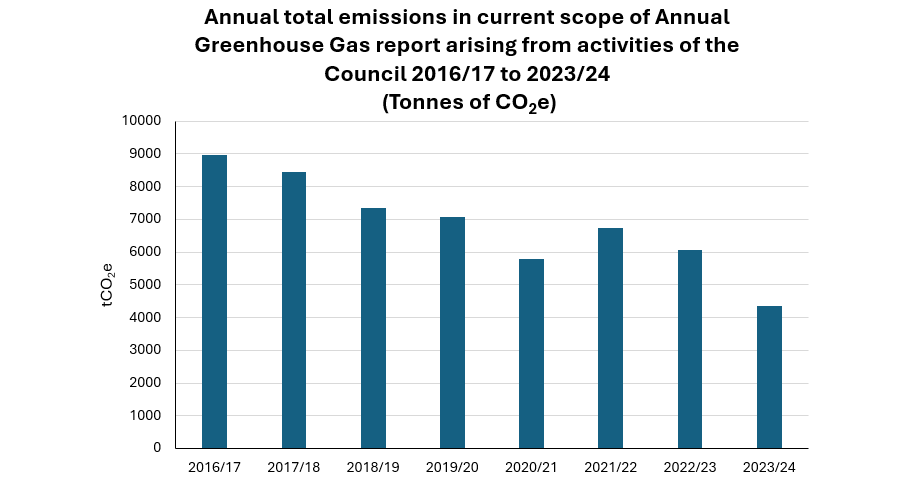
In 2023/24, total quantified emissions, at 4358 tonnes of CO2 equivalent (tCO2e), were down by 1706 tCO2e, that’s a decrease of 28.1% from 2022/23.
The chart below shows the council’s total emissions for each of the last seven years. For the years 2016/17, the data for the former districts of Suffolk Coastal and Waveney, which joined to form East Suffolk Council in 2019/20, are combined.
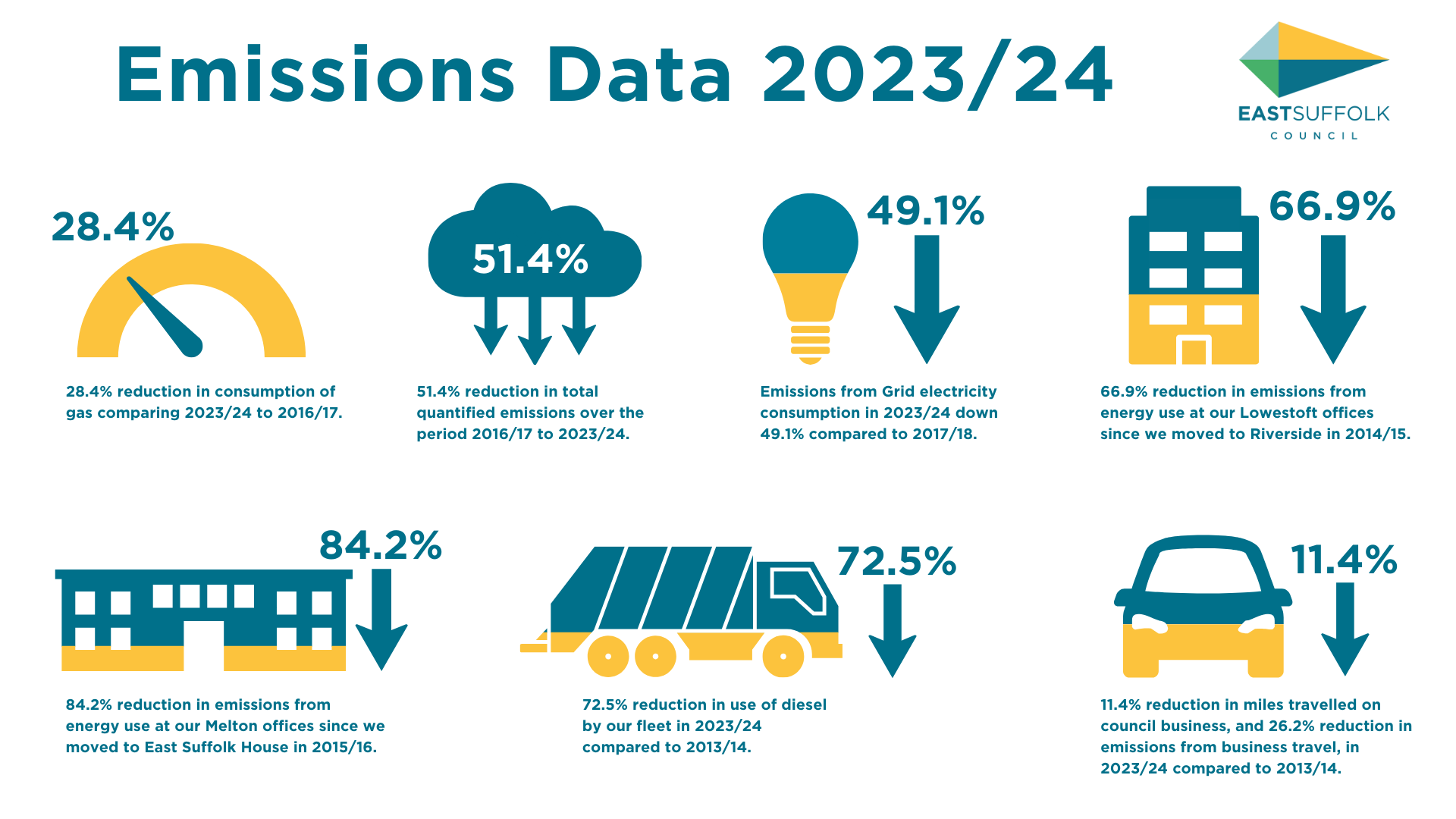
Over the period from 2016/17 to 2023/24, the council’s emissions overall have reduced by 51.4%.
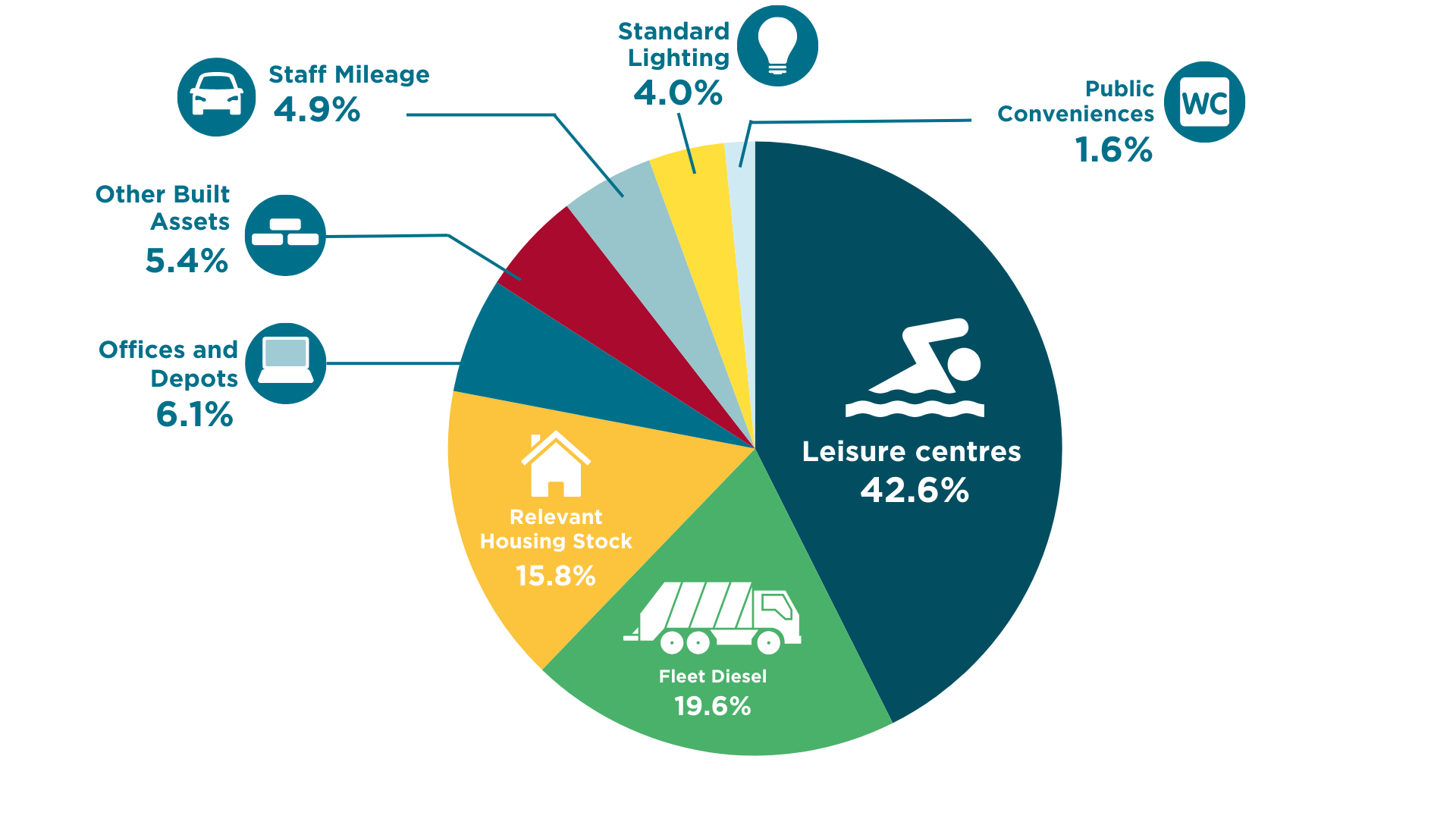
The pie chart below shows the council’s total quantified emissions for 2023/24 according to the contributions made by various activities. Note that the three largest contributors (leisure centres, fleet and relevant housing assets) are collectively responsible for approximately 78% of the emissions overall. For this reason, the council’s emissions reduction plans are focused on these key aspects.
Fleet
Whilst longer term solutions such as hydrogen as fuel remain under investigation, the council has commenced the implementation, as an interim alternative to diesel, the use of Hydrotreated Vegetable Oil as fuel for the majority of its fleet which are compatible with this renewable fuel as a direct substitute for diesel.
The fleet commenced limited use of this fuel from June 2022 onwards, and as the proportion of the fleet using it increases, it has the potential to make significant reductions in the emissions attributable to the fleet. In 2023/24, the combined Scope 1 and Scope 3 emissions arising from the fleet were down by 66.9% compared to 2022/23.
The council currently has ten battery electric (BEV) vehicles on its fleet, comprised of four electric vans and three electric cars on our car parks management fleet, and three electric pool cars.
In 2023/24, these ten vehicles travelled a total of 157,738 km (98,014 miles) on council business that would otherwise have been incurred using diesel or petrol powered vehicles, providing an estimated non-deductible avoidance of around 16 tCO2e.
Staff business mileage
Whilst recognising that some business travel is essential, for example to carry out site inspections and to engage with our communities, we also recognise that much business travel, for example to attend meetings internally and with other organisations, can be conducted effectively through the use of remote technology and this approach has been embedded in our new system of agile working.
In 2023/24, emissions from our business mileage were down 9%, when compared to the year 2019/20 (the last financial year before Covid restrictions took effect).
Solar PV
Solar PV arrays are installed on one of the council’s depots, three of its leisure centres, and ten of its retirement and communal housing schemes, providing a total combined capacity of approximately 293 kW, providing renewable energy and helping to contribute to the electricity requirements of these sites.